Access control manages who can enter a space using credentials — cards, PINs, or mobile apps. A video intercom allows two-way audio and video communication between a visitor and the property occupant before entry is granted. The two systems serve different functions and are often used together: access control for credentialed users, video intercom for visitors and deliveries.
What Is the Difference Between Access Control and a Video Intercom System?
Access control manages who can enter a space using credentials — cards, PINs, or mobile apps. A video intercom allows two-way audio and video communication between a visitor and the property occupant before entry is granted. The two systems serve different functions and are often used together: access control for credentialed users, video intercom for visitors and deliveries.
What Access Control Does
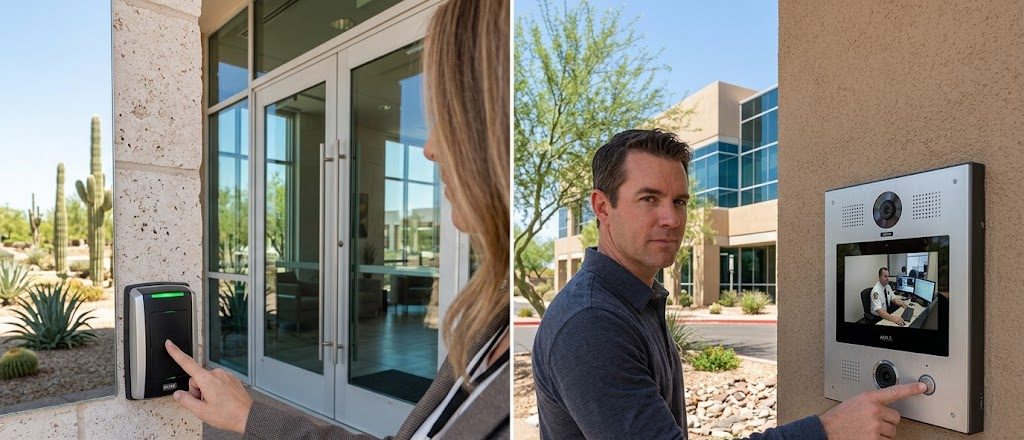
An access control system manages entry for known, credentialed users. Employees, residents, or authorized personnel present a credential — a card, a PIN, a mobile phone, or a biometric marker — and the system decides whether to grant or deny access based on pre-set rules.
The key characteristic of access control is that it is self-service. A credentialed user does not need to interact with another person to enter. They present their credential, the system verifies it, and the door or gate unlocks. Every transaction is logged automatically.
Access control is the right tool for managing recurring, authorized access — employees coming to work, residents entering a community, authorized contractors with time-limited credentials.
What a Video Intercom System Does
A video intercom handles the other access scenario: visitors who are not credentialed users. A delivery driver, a guest, a prospective tenant, a service provider making a first visit — none of these people have a credential in the system.
A video intercom panel mounted at the entrance allows the visitor to identify themselves visually and verbally. The property occupant or manager sees and speaks with the visitor on a screen or mobile device, decides whether to admit them, and remotely releases the gate or door. The visitor never needs a credential — the human judgment of the person answering the intercom replaces the automated credential check.
The Key Difference in How They Handle Visitors
Access control does not handle unknown visitors well. An unknown person at the gate either gets in because they tailgate behind a credentialed user, or they do not get in at all. There is no mechanism for a legitimate visitor to request access — only for credentialed users to use theirs.
Video intercom is designed specifically for the unknown visitor scenario. It provides a structured, secure process for visitor verification without requiring credentials to be issued in advance. For high-visit-volume properties — apartment buildings, professional offices, HOA communities with frequent deliveries — video intercom handles the daily visitor flow that access control cannot.
When You Need Both Systems
Most commercial and HOA applications benefit from both systems working together. Credentialed users — employees, residents — use the access control system: tap a card, enter a code, use their phone. Unknown visitors — guests, deliveries, service providers — use the video intercom: call through, speak with someone, get buzzed in.
When the two systems are integrated on a common platform, every entry event — credentialed access and intercom-granted access — is logged together. The property manager has a complete picture of all entry activity from one interface.
ParkPro designs integrated systems that include both
access control systems and video intercom on a common platform — particularly for HOA communities and commercial properties where both credentialed and visitor access are daily operational realities.
Video Intercom for HOA and Gated Communities
For HOA gated communities across Gilbert, Chandler, Scottsdale, and Mesa, the combination of telephone or video entry for visitors and resident credentials for self-service access is the standard configuration.
Residents use a key fob, card, or keypad code to open the gate — no call required. Guests call through the video intercom, the resident answers on their phone, sees who is at the gate, and grants access with a button press. Delivery drivers access a package delivery system or call through to the management office during business hours.
This configuration handles the full range of daily access scenarios at a gated community without requiring a staffed guardhouse.
Video Intercom for Commercial Properties
Commercial properties use video intercom primarily for visitor management at main entrances and loading docks. A visitor arrives at the front door, requests entry through the video panel, and staff at a reception desk or any mobile device can see and speak with the visitor before unlocking the door.
Cloud-based video intercom systems route visitor calls to any phone or device — a receptionist, a mobile phone, or a shared office device. Staff working remotely or distributed across a building can still manage visitor access from wherever they are.
ParkPro Installs Both Systems Across the Phoenix Metro
ParkPro serves HOA communities, commercial properties, and multi-tenant facilities across Phoenix, Mesa, Scottsdale, Chandler, Gilbert, Tempe, and Avondale. Whether you need access control, video intercom, or an integrated system combining both, the team will assess your property and design the right configuration.
parkpro.com/contact/ to schedule a free consultation.